
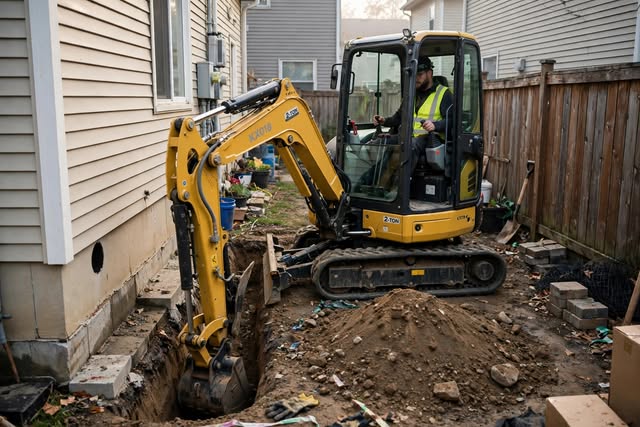
A tiltrotator sits between your stick and your bucket. It lets the bucket tip side to side and spin all the way around, so you can grade a slope, cut a ditch at an angle or set a pipe without walking the machine. In Scandinavia it's standard kit. Here it's still the attachment most guys watch on Instagram and never price out.
There are really three things sold under the "360 bucket" banner, and they aren't the same tool.
| Type | What it does | Plumbing | Ballpark |
|---|---|---|---|
| Full tiltrotator Engcon, Rototilt, Steelwrist | 360° rotation, about 45° tilt each way, quick coupler underneath for any attachment, optional gripper | Dedicated hydraulics, control unit, usually new joysticks | Quote it. Big-machine units run $28k to $65k installed1 |
| Tilt-rotate bucket e.g. CMP Attachments, Minnesota | 360° rotation, 35° tilt each way, bucket bolts to the head | Hoses to your boom lines. No computer, no joystick swap | $9k to $12k2 |
| Tilt coupler or tilt bucket Helac PowerTilt, Werk-Brau | Tilt only. Up to 180° on a PowerTilt, 45° each way on a tilt bucket | One aux circuit | The cheapest real upgrade |
European: the real deal, priced like it
The Swedish makers invented this category in the 1980s and still own it. Steelwrist builds the X04 for 2 to 4 tonne machines and the X07 for 5 to 7 tonnes, plus its XTR line from 0 to 2 tonnes up. Every model tilts 45° each way with unlimited rotation.3 Engcon's Series 1 covers 1 to 6 tonne machines.4 Rototilt has run a North American office out of Ontario since 2008.1
What you're paying for:
- Cast steel and low build height. Less height between the stick and the bucket means less breakout lost.
- Proportional control. Tilt and rotate sit on rollers on your joysticks, so they move while the boom moves. That's where the speed comes from.
- A quick coupler underneath. Swap from the ditching bucket to a grading beam or forks without leaving the seat, if you spec hydraulic quick couplers.
- Machine control ready. Trimble and Leica integrations exist for grade work.1
The catch is money and install. Equipment World talked to contractors who spent $28,000 on a Steelwrist for an 8-ton Kubota KX080, and $65,000 all-in for an Engcon package with buckets, a grading beam and a gripper. Plan on two to three days of dealer labor for the install.1 Mini-sized units cost less than that, but the control kit and install don't shrink as much as the steel does, so get a real quote.
Those same contractors reported 25% more production on grading and backfill, and one fence teardown dropped from three hours to 45 minutes.1 That's the case for buying one: it pays when the machine works every day.
US-made: most of the trick on the lines you already have
A few American shops build the simple version. CMP Attachments in Minnesota sells a modular tilt-rotate bucket for machines from 6,000 to 35,000 lb: 360° rotation, 35° dual-cylinder tilt each way, plumbed to your existing boom hoses. No computer and no joystick swap. They price it around $9k to $12k and say outright it is not a replacement for a $50k quick-coupler tiltrotator.2 We respect that kind of honesty.
The trade-offs are real. The bucket bolts on, so swapping attachments is a wrench job, not a button. Tilt and rotate usually share your aux circuits through a diverter or a second circuit, so you won't feather rotation while you swing like you can on a proportional system. For a landscaper or owner-operator on a 3 to 6 ton mini, it's the most sensible way in.
If you only need angle, not rotation, a tilt coupler like Parker's Helac PowerTilt tilts any bucket up to 180°.5 A hydraulic tilt bucket like Werk-Brau's tilts 45° left or right on dual cylinders.6 Either one is a big step up for grading and ditch work, for a fraction of a tiltrotator.
Chinese: the cheapest way in, if you do the homework
Search Alibaba and you'll find tilt rotators listed around $7,000 for 4 to 10 ton machines, and tilt buckets for far less.7 Some are fine. Some are a nice paint job over the wrong steel. The listing photo won't tell you which, so go through these before you pay:
- Pressure rating against your aux relief. If your machine runs 3,500 psi and the rotator motor is rated lower, you'll find out the expensive way.
- Case drain. Rotation motors often want one. If your mini doesn't have a case drain line, ask what happens without it before you buy.
- Pin diameter, pin spread and ear width, measured off your actual stick and coupler. Don't trust a model-number fit list.
- Seal kits and the swivel. Ask for part numbers and US stock. A leaking swivel with a six-week boat ride for parts parks the machine.
- Who stands behind it in the US. A US distributor with a phone number is worth paying more for.
- Freight and customs time. Factor it into the "cheap" price.
Whatever you buy: every one of these adds weight and height at the end of your stick. That costs you lift capacity and some breakout force. Pull your machine's lift chart and subtract the attachment weight before you plan to set pipe or block with it.
Run it daily
Best control, quick coupler, machine-control ready. Worth it if the machine earns every day.
The sweet spot
Most of the capability on your existing lines, for a fraction of the price. Bolt-on bucket.
Homework first
Can work. Check pressure, drain, pins and seals, and know where your parts come from.
How we put this together
We haven't run every one of these ourselves. This guide is built from manufacturer specs, published prices and contractor reports, with sources below. Run one? Tell us how it's held up. Owner reports get added to the next update, good and bad.